Whole Life Insurance Rates by Age Chart: What You’ll Pay and Why
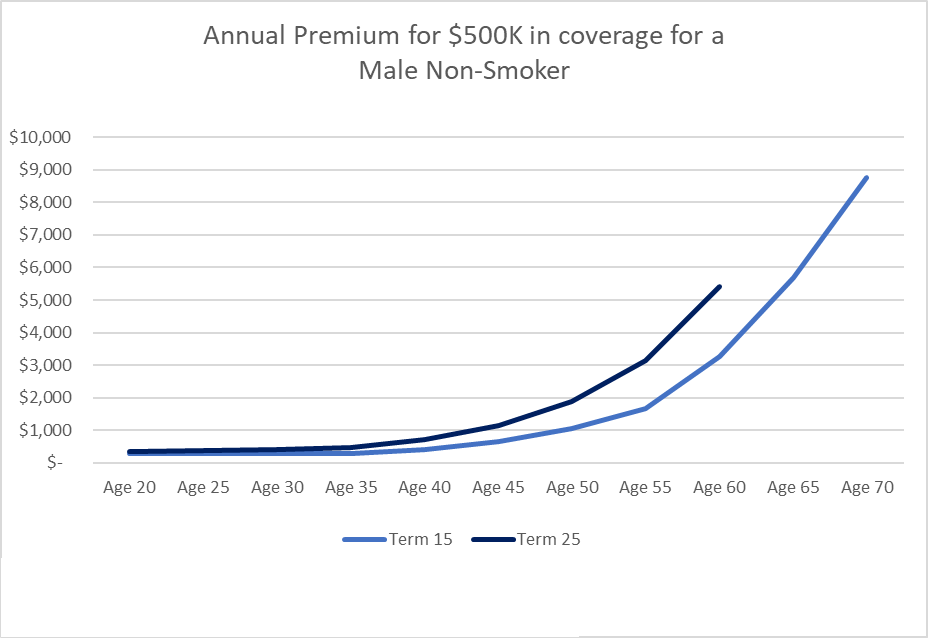
The single biggest factor in your whole life insurance premium is the age at which you buy it. Not your health. Not your coverage amount. Not even the insurer you choose. Age is the primary driver, and the difference between buying at 30 versus buying at 50 can add up to tens of thousands of dollars in extra premiums over the life of a policy.
This guide gives you the rate charts you’re looking for, but it also explains the numbers behind them. Understanding why premiums scale the way they do helps you make a smarter buying decision, whether you’re evaluating coverage for the first time, comparing quotes from multiple carriers, or trying to decide whether to buy now or wait.
All rates in this guide are based on national market averages for healthy, non-smoking applicants unless otherwise noted. Actual quotes will vary by carrier, state, underwriting class, and any riders you add to the policy.
Whole Life Insurance Rates by Age: $250,000 Coverage
The table below shows average monthly premiums for a $250,000 whole life insurance policy. These figures reflect what a healthy non-smoker in standard to preferred health can expect to pay at each age. Male and female rates are shown separately because most insurers price gender differently based on actuarial life expectancy data.
| Age | Male Monthly Premium | Female Monthly Premium |
|---|---|---|
| 20 | $155 – $185 | $135 – $165 |
| 25 | $185 – $220 | $160 – $195 |
| 30 | $210 – $250 | $185 – $225 |
| 35 | $250 – $300 | $220 – $270 |
| 40 | $320 – $390 | $280 – $340 |
| 45 | $420 – $520 | $360 – $450 |
| 50 | $600 – $750 | $500 – $650 |
| 55 | $850 – $1,050 | $700 – $900 |
| 60 | $1,200 – $1,500 | $1,000 – $1,300 |
| 65 | $1,700 – $2,100 | $1,400 – $1,800 |
| 70 | $2,400 – $3,000 | $2,000 – $2,600 |
A few things stand out when you look at this table carefully. From age 30 to age 50, the male monthly premium roughly triples. From 50 to 70, it roughly quadruples again. The compounding nature of this escalation is why insurance advisors consistently say that the best time to buy whole life insurance is as early in life as you realistically can afford it. Every year you wait, the gap between what you would have paid and what you will now pay gets slightly wider.
Women pay less across every age bracket for reasons covered later in this guide. The gap narrows somewhat at older ages but remains consistent throughout the standard purchasing range.
Whole Life Insurance Rates by Coverage Amount
Coverage amount scales premiums in a reasonably proportional way, though the relationship isn’t perfectly linear. Larger policies sometimes benefit from slight rate efficiency at higher face amounts. The table below shows approximate monthly premiums for a 40-year-old male non-smoker in standard health across multiple coverage levels.
| Coverage Amount | Male Age 40 (Monthly) | Female Age 40 (Monthly) |
|---|---|---|
| $100,000 | $135 – $165 | $115 – $140 |
| $250,000 | $320 – $390 | $280 – $340 |
| $500,000 | $625 – $760 | $540 – $660 |
| $1,000,000 | $1,200 – $1,480 | $1,040 – $1,280 |
As you can see, the $500,000 policy costs roughly double the $250,000 policy, while a $1 million policy runs close to four times the $250,000 rate. This is useful context when deciding how much coverage to apply for. Buying the right amount upfront is generally more cost-effective than buying a smaller policy and trying to add coverage later at an older age.
To get a personalized estimate for your specific age and coverage needs, our Life Insurance Calculator gives you a quick baseline before you speak with an advisor.
Whole Life Insurance Rates by Health Classification
The rate tables above assume standard to preferred health. In reality, insurers place applicants into one of several health classifications during underwriting, and your classification has a major impact on your final premium. Here’s how the classes typically work and what they mean for your cost.
Preferred Plus (Super Preferred)
This is the best classification available. It goes to applicants who are in exceptional health, have no significant family history of early death from major illnesses, have a clean driving record, and are within the ideal height and weight range for their age. Preferred Plus rates are the lowest available and represent the “headline” numbers you often see in online quotes. Not everyone qualifies.
Preferred
One step below Preferred Plus. Applicants in this class are in very good health with minor medical history that doesn’t significantly affect mortality risk. Preferred rates are close to Preferred Plus rates and still very competitive.
Standard
Standard classification applies to applicants who have some health considerations, such as slightly elevated blood pressure or cholesterol that is managed with medication, a BMI that falls outside the preferred range, or a family history of certain conditions. Standard rates are higher than Preferred, often by 20% to 40%.
Substandard (Table-Rated)
Applicants with more significant health histories may be offered coverage at a “table rating,” which adds a percentage surcharge above the standard rate. Table ratings run from Table 1 (mildest) through Table 16 (most severe), though most practical cases fall in the lower end of that range. Some conditions result in outright declination rather than a table rating, though this varies by insurer.
The table below shows how health classification affects the monthly premium for a 40-year-old male seeking $250,000 in whole life coverage.
| Health Classification | Estimated Monthly Premium (Male, Age 40, $250,000) |
|---|---|
| Preferred Plus | $295 – $340 |
| Preferred | $320 – $370 |
| Standard | $390 – $460 |
| Table 2 (Substandard) | $480 – $560 |
| Table 4 (Substandard) | $570 – $670 |
| Tobacco User (Standard) | $650 – $800 |
The tobacco user rate deserves special attention. Smoking status alone can nearly double your premium at any age. Insurers typically require a 12-month period of confirmed non-use before reclassifying a former smoker into a non-tobacco underwriting class. If you currently smoke and are planning to quit, that decision has meaningful financial implications for what you’ll pay for life insurance going forward.
Insurers assess health during underwriting by reviewing your blood pressure readings, cholesterol levels, blood glucose, BMI, prescription history, driving record, family medical history, and results from a paramedical exam that is usually included as part of the application process at no charge to you.
Smoker vs. Non-Smoker Rate Comparison by Age
Because tobacco use affects rates so significantly, it’s worth its own dedicated table. The figures below compare non-smoker and smoker monthly premiums for a $250,000 policy across different ages for males.
| Age | Non-Smoker (Male) | Smoker (Male) | Approximate Difference |
|---|---|---|---|
| 30 | $210 – $250 | $390 – $470 | +$180/month |
| 40 | $320 – $390 | $650 – $800 | +$340/month |
| 50 | $600 – $750 | $1,150 – $1,450 | +$580/month |
| 60 | $1,200 – $1,500 | $2,100 – $2,600 | +$850/month |
For a 40-year-old male smoker versus a non-smoker of the same age, the monthly difference is approximately $340. Over a 30-year period, that difference accumulates to roughly $122,000 in additional premium payments for the exact same death benefit. This is one of the clearest financial cases for quitting smoking that exists, independent of any health argument.
Why Do Whole Life Insurance Rates Increase With Age?
The relationship between age and premium isn’t arbitrary. It’s based on actuarial science, which is the statistical study of risk and life expectancy applied to insurance pricing.
Every life insurance policy the carrier sells will eventually result in a claim. The question for the insurer is when. A policy sold to a 25-year-old may not result in a claim for 55 or 60 years. A policy sold to a 65-year-old may result in a claim within 10 to 15 years. The premium must account for that difference in timing, because earlier claims mean less time for the insurer to collect and invest premiums before paying out the death benefit.
Insurers use mortality tables, which are statistical charts that show the probability of death at each age based on large population data sets. The most widely referenced in the U.S. are the Commissioners Standard Ordinary (CSO) tables, which the National Association of Insurance Commissioners updates periodically to reflect current life expectancy trends. Insurers build their own proprietary mortality assumptions on top of these baseline tables, adjusted for their specific underwriting experience.
The premium you pay is essentially the insurer’s calculation of what they need to collect from you over your lifetime to fund the eventual death benefit payment, plus expenses and profit margin, all discounted for investment returns they expect to earn on your premiums while holding them. This is why whole life premiums, unlike term life premiums, don’t change once you buy. The insurer has priced the entire expected future cost into that fixed rate at the time of issue.
To see how this pricing logic connects to broader insurance economics, our article on how insurance companies make a profit while paying claims walks through the financial mechanics behind insurance pricing.
Why Women Pay Less for Whole Life Insurance
Across virtually every insurer and every age bracket, women pay lower whole life insurance premiums than men. This isn’t a pricing preference, it’s a reflection of actuarial data that has been consistent across decades of mortality statistics.
Women in the United States live an average of 5 to 6 years longer than men, according to the Centers for Disease Control and Prevention. As of recent data, average life expectancy at birth is approximately 79 to 81 years for women and 73 to 75 years for men. That gap means that statistically, a female policyholder represents a lower near-term mortality risk than a male policyholder of the same age and health classification.
From the insurer’s perspective, a longer expected lifespan means more premium payments before a claim, which allows the insurer to collect and invest more funds before paying out. That lower expected cost gets passed to female applicants in the form of lower premiums.
It’s worth noting that some states have moved to restrict or prohibit gender-based pricing in certain insurance lines. For auto insurance, a growing number of states require gender-neutral rating. Life insurance has been slower to change in this regard, and gender-differentiated pricing remains standard practice for whole life products in most U.S. states.
Whole Life vs. Term Life: Why the Rate Difference Is So Large
If you’ve compared whole life and term life quotes, you’ve probably noticed that term life is dramatically cheaper for the same death benefit amount. A 35-year-old male might pay $250 per month for a $250,000 whole life policy, while the equivalent 20-year term policy costs $20 to $30 per month. That’s a tenfold difference in premium for the same death benefit on paper.
The reason comes down to what each product actually is.
Term life insurance is pure death benefit coverage for a fixed period, typically 10, 20, or 30 years. If you die during the term, your beneficiaries collect. If the term expires and you’re still alive, the policy ends with nothing paid out, and the insurer keeps the premiums. The insurer only pays on a fraction of term policies ever issued, which keeps the cost low.
Whole life insurance, by contrast, guarantees a payout regardless of when you die. The insurer knows with certainty that they will eventually pay the death benefit on every whole life policy they sell. That certainty of eventual payout is a core driver of the higher premium.
But whole life premiums aren’t just paying for future death benefit coverage. They also fund a cash value account that grows on a tax-deferred basis throughout the life of the policy. Part of every premium goes toward building this internal savings component, which you can access through policy loans or withdrawals, use as collateral, or allow to grow as part of your long-term financial plan. The death benefit, the permanent coverage, and the cash value accumulation are all being funded by that premium.
Whether that trade-off makes sense for your situation depends on your financial goals, your timeline, and what role life insurance plays in your broader plan. For pure income replacement needs over a defined period, term life is typically the more cost-efficient choice. For permanent coverage needs, estate planning, or building tax-deferred cash value over decades, whole life serves a different function that term simply can’t replicate.
How Cash Value Grows at Different Ages
One of the most misunderstood aspects of whole life insurance is how cash value accumulates over time and how the age at which you buy affects that accumulation.
Cash value growth in a whole life policy is slow in the early years and accelerates over time. In the first several years, a significant portion of your premium covers the insurer’s acquisition costs and mortality charges, with a relatively small amount going toward cash value. As the policy matures, the ratio shifts, and the cash value component grows more substantially.
Buying at a younger age means more years for cash value to compound before you need it. A policyholder who buys at 30 and holds the policy to age 65 has 35 years of tax-deferred cash value growth. A policyholder who buys at 50 and holds to 65 has only 15 years. The difference in accumulated cash value at retirement can be substantial.
The table below gives a general illustration of how cash value might accumulate over time for a $250,000 whole life policy purchased by a 35-year-old male in preferred health. These are illustrative figures and actual results will vary by carrier and dividend performance.
| Policy Year | Age | Approximate Cash Value | Death Benefit |
|---|---|---|---|
| 5 | 40 | $10,000 – $18,000 | $250,000 |
| 10 | 45 | $30,000 – $45,000 | $250,000 |
| 20 | 55 | $90,000 – $130,000 | $250,000+ |
| 30 | 65 | $175,000 – $230,000 | $250,000+ |
With participating policies at mutual insurers, dividends can be used to purchase paid-up additions, which increase both the death benefit and the cash value beyond the base policy guarantees. This is why long-term whole life policies often end up with death benefits meaningfully larger than the original face amount after decades of dividend reinvestment.
How Dividends Affect Your Long-Term Cost
Not all whole life insurance policies pay dividends. Participating policies issued by mutual insurance companies, including well-known names like Northwestern Mutual, MassMutual, and New York Life, share company profits with policyholders through annual dividends when their financial performance warrants it.
Dividends are not guaranteed. Insurers classify them as a return of excess premium rather than a guaranteed benefit, which is why they aren’t taxable as income in most cases. But mutual insurers with long histories of consistent dividend payments have a strong track record that many buyers find reassuring.
When dividends are paid, you typically have several options for how to use them:
- Take them as cash
- Apply them to reduce your next premium payment
- Use them to purchase paid-up additions, which increase your death benefit and cash value
- Leave them on deposit with the insurer to accumulate interest
Over a 30 or 40-year policy, the compounding effect of reinvesting dividends into paid-up additions can significantly enhance both the death benefit and cash value compared to a non-participating policy of the same original face amount.
Non-participating policies, often issued by stock companies, don’t pay dividends but may offer lower base premiums or more flexibility in policy structure. Neither is inherently better. It depends on your goals and how you intend to use the policy over time.
The Best Age to Buy Whole Life Insurance
From a pure cost perspective, the best age to buy whole life insurance is as young as possible. Premiums are lowest when you’re young, your health is likely at its best, and you have the most years ahead for cash value to compound.
That said, the decision isn’t purely about locking in a low rate. It’s about whether whole life insurance fits your actual financial situation and goals at the time you’re buying it.
Buying in your 20s gives you the lowest possible premium and the most cash value accumulation time, but only makes sense if you have dependents, financial obligations, or estate planning goals that require permanent coverage at that stage of life. Paying for a whole life policy when term insurance would adequately serve your current needs isn’t necessarily the right call just because the rate is low.
Your 30s and early 40s represent a sweet spot for many buyers. You likely have family financial responsibilities, a mortgage, and a clearer picture of your long-term income trajectory. Premiums are still relatively affordable, and you still have meaningful decades of cash value growth ahead.
Buying in your 50s and 60s is more expensive but can still serve legitimate purposes, particularly for estate planning, business succession, or final expense coverage. The cash value component becomes less of a financial planning tool at these ages given the shorter accumulation runway, but the permanent death benefit and the ability to lock in coverage regardless of future health changes remain valuable.
There’s also a technique worth knowing about for buyers who are close to a birthday: backdating. By setting your policy’s effective date a few months back, you can lock in the premium rate associated with your current age rather than your upcoming birthday age, which reduces your lifetime premium cost. Our full explanation of what happens when an insurance policy is backdated walks through exactly how this strategy works and when it makes financial sense.
Riders That Affect Your Whole Life Premium
The base whole life policy rates shown in this guide don’t include any optional riders. Riders are add-on provisions that modify or enhance your coverage, and they add to the base premium. Here are the most common ones and what they cost:
Waiver of Premium Rider
If you become totally disabled and can no longer work, a waiver of premium rider suspends your premium payments while keeping the policy fully in force. This rider typically adds 3% to 8% to your base premium depending on your age and occupation. For most buyers, the added protection justifies the modest cost.
Accidental Death Benefit Rider
Also called double indemnity, this rider pays an additional death benefit equal to the face amount if death results from a covered accident. It’s relatively inexpensive and adds a layer of protection that may be relevant for policyholders with physically demanding occupations or active lifestyles.
Paid-Up Additions Rider (PUA)
A paid-up additions rider allows you to contribute additional premium above the base amount to accelerate cash value growth. PUA riders are popular with policyholders who want to use whole life as a significant wealth-building tool, sometimes called “infinite banking.” The additional contributions purchase small fully paid-up policies that increase both death benefit and cash value without triggering new underwriting. This rider can substantially increase your total premium, but it’s voluntary and controllable.
Term Life Rider
Some buyers want permanent base coverage with additional temporary coverage layered on top for a specific period. A term life rider adds a defined amount of term coverage to the whole life base for a set number of years, at a lower cost than buying a separate term policy. It’s a practical way to boost coverage during high-need years like when children are young and mortgage debt is highest.
Guaranteed Insurability Rider
This rider allows you to purchase additional life insurance coverage at specified future dates without undergoing new medical underwriting, regardless of your health at that time. It’s particularly valuable for younger buyers who expect their coverage needs to grow over time and want to lock in the ability to increase coverage even if health issues arise in the future.
Long-Term Care Rider
A long-term care rider allows you to accelerate a portion of your death benefit to cover long-term care expenses if you become unable to perform daily living activities independently. This rider essentially turns part of your life insurance into a long-term care funding mechanism, which can be a cost-effective alternative to a standalone long-term care policy for some buyers.
How to Get the Best Whole Life Insurance Rate Available
Understanding the rate tables is only half the picture. The other half is knowing how to position yourself as an applicant to qualify for the best rate your health and circumstances allow.
Apply While You’re Healthy
This sounds obvious, but it’s frequently put off until health changes make it complicated. Chronic conditions, new medications, and changes in BMI all affect your underwriting class. The best time to apply is before any of those changes occur, not after. A condition that is well-controlled and stable today may not prevent you from getting preferred rates, but waiting until it progresses or until additional conditions develop will cost you.
Compare Multiple Carriers
Different insurers weigh the same health factors differently. One carrier might place a well-controlled diabetic into standard class while another offers preferred. One carrier might be more lenient on family history of heart disease while another isn’t. Working with an independent agent who has access to multiple carriers, rather than a captive agent who only sells one company’s products, gives you the ability to find the carrier that rates your specific health profile most favorably.
Be Accurate and Thorough on Your Application
Misrepresenting or omitting health information on a life insurance application can result in policy rescission and claim denial during the contestability period. Be complete and accurate. If there are conditions in your history that you’re unsure how to disclose, ask your broker to guide you through it rather than leaving things out.
Work on Modifiable Risk Factors Before Applying
If you smoke, quitting and maintaining non-smoker status for 12 months before applying can halve your premium. If your BMI is just above the preferred threshold, losing even a modest amount of weight before applying can push you into a better rate class. If your blood pressure is slightly elevated, getting it under control with medication or lifestyle changes before applying may move you from standard to preferred. These aren’t small improvements. A rate class change of one step can save you significant money every month for the rest of the policy’s life.
Consider Backdating to Lock In a Lower Age Rate
If you’re within a few months of your next birthday, ask your broker whether backdating the policy to your current age makes financial sense. As explained above, this strategy sets your policy’s effective date back a few months so your premium is calculated at your current age rather than the age you’ll be at by the time all the paperwork processes. The upfront cost of back premiums is often recovered quickly through the ongoing premium savings.
Our guide on how insurance protects your financial future provides useful context for thinking about how a whole life policy fits into your broader financial protection strategy alongside other coverage types.
Whole Life Insurance for Business Owners and High-Net-Worth Planning
The rates in this guide focus on personal coverage, but whole life insurance also serves important roles in business and estate planning contexts where the calculus looks somewhat different.
In a business context, whole life policies are frequently used to fund buy-sell agreements between business partners. If one partner dies, the surviving partner uses the life insurance proceeds to purchase the deceased partner’s share from their estate, enabling business continuity without the complications of an unwanted new business partner or a forced fire sale. Our article on what corporate insurance covers explains how these business ownership structures interact with insurance planning.
For high-net-worth individuals, whole life insurance plays a role in estate liquidity planning. Large estates can face significant estate tax obligations, and without liquid assets available to pay those taxes, heirs might be forced to sell property, investments, or a family business at an inopportune time. A whole life death benefit provides a ready source of tax-free liquidity precisely when it’s most needed. Our detailed breakdown of what a $1 million insurance policy provides is useful context for evaluating larger coverage amounts in both personal and business scenarios.
Frequently Asked Questions
Does whole life insurance get more expensive as you age after you buy it?
No. Once you purchase a whole life policy, your premium is fixed for the life of the policy regardless of how old you get or what happens to your health. This is one of the defining features of whole life insurance and a significant advantage over renewable term policies, where premiums reset to current age rates at each renewal. The rate you’re quoted at application is the rate you’ll pay forever, which is why buying earlier captures a lower fixed rate for the long term.
Can I get whole life insurance at 70 or older?
Yes, though your options narrow and premiums become very high at advanced ages. Some carriers offer policies up to age 80 or even 85, though coverage amounts are often limited and the products may be simplified issue or guaranteed issue policies that don’t require full medical underwriting. These products typically come with either waiting periods before full death benefits are payable, or much higher premiums that reflect the insurer’s inability to medically screen the applicant. For most buyers in their 70s, final expense or burial insurance products serve the practical need at a more accessible price point than traditional whole life.
How do I know if I’m getting a competitive rate?
The most reliable way is to get quotes from at least three to five carriers. Since whole life pricing varies by insurer, getting a single quote doesn’t tell you whether the rate is competitive. An independent broker with access to multiple carriers can run those comparisons for you. Pay attention to the total premium, the death benefit, the cash value projections at specific future dates, and the dividend history for participating policies. A lower premium that comes with weaker cash value performance or a thinner dividend history may not be the better deal over the long run.
Does the insurer matter beyond price?
Yes, significantly. Whole life is a long-term commitment, potentially spanning 40 or 50 years or more. You need the insurer to still be financially strong and able to pay claims decades from now. Check financial strength ratings from A.M. Best, Moody’s, and Standard and Poor’s before committing to any carrier. A ratings and above are generally considered strong. For participating policies, review the insurer’s dividend history over the past 20 to 30 years as an indicator of long-term performance consistency.
Is whole life insurance worth it compared to term plus investing the difference?
This is one of the most debated questions in personal finance, and the honest answer is that it depends on your goals, tax situation, investment discipline, and what role permanent insurance plays in your overall plan. For buyers who have maxed out tax-advantaged retirement accounts and want additional tax-deferred growth, or who have permanent insurance needs like estate planning or business succession, whole life can be a strong fit. For buyers who primarily need income replacement coverage during working years, term life combined with disciplined investing often produces better financial outcomes. There’s no universal right answer, and comparing the two strategies with your specific numbers is the only way to make an informed decision.
What happens if I can’t afford the premiums anymore?
Whole life policies have several options for policyholders who can no longer maintain premiums. The most common are: using accumulated cash value to pay premiums, converting the policy to a reduced paid-up policy with a lower death benefit but no further premium required, or surrendering the policy entirely in exchange for the accumulated cash value. Your policy documents will specify which options are available and under what conditions. Speaking with your insurer or advisor before simply stopping payments is important, because lapsing a policy can have tax consequences depending on how much cash value has accumulated.
How does whole life insurance fit with other types of financial protection?
Whole life is one piece of a broader financial protection picture that typically also includes health insurance, disability insurance, auto and home coverage, and retirement savings. Understanding how each piece fits together is what separates adequate coverage from truly comprehensive protection. Our overview of how insurance protects you from financial loss covers the full picture of how different coverage types work together.
Ready to Get Your Personalized Whole Life Rate?
Rate charts give you a solid starting point for understanding what whole life insurance costs at different ages. But your actual premium will depend on your specific health, your coverage goals, the carrier you choose, and the riders you add. The only way to know your real rate is to apply with the right insurer for your specific situation.
Use our Life Insurance Calculator to get a personalized estimate based on your age and coverage amount. Or reach out directly to the team at Matrix Insurance for a no-obligation consultation. We’ll compare rates across multiple carriers, identify the best health classification for your profile, and make sure you’re not paying more than you need to for the coverage your family depends on.














14 comments